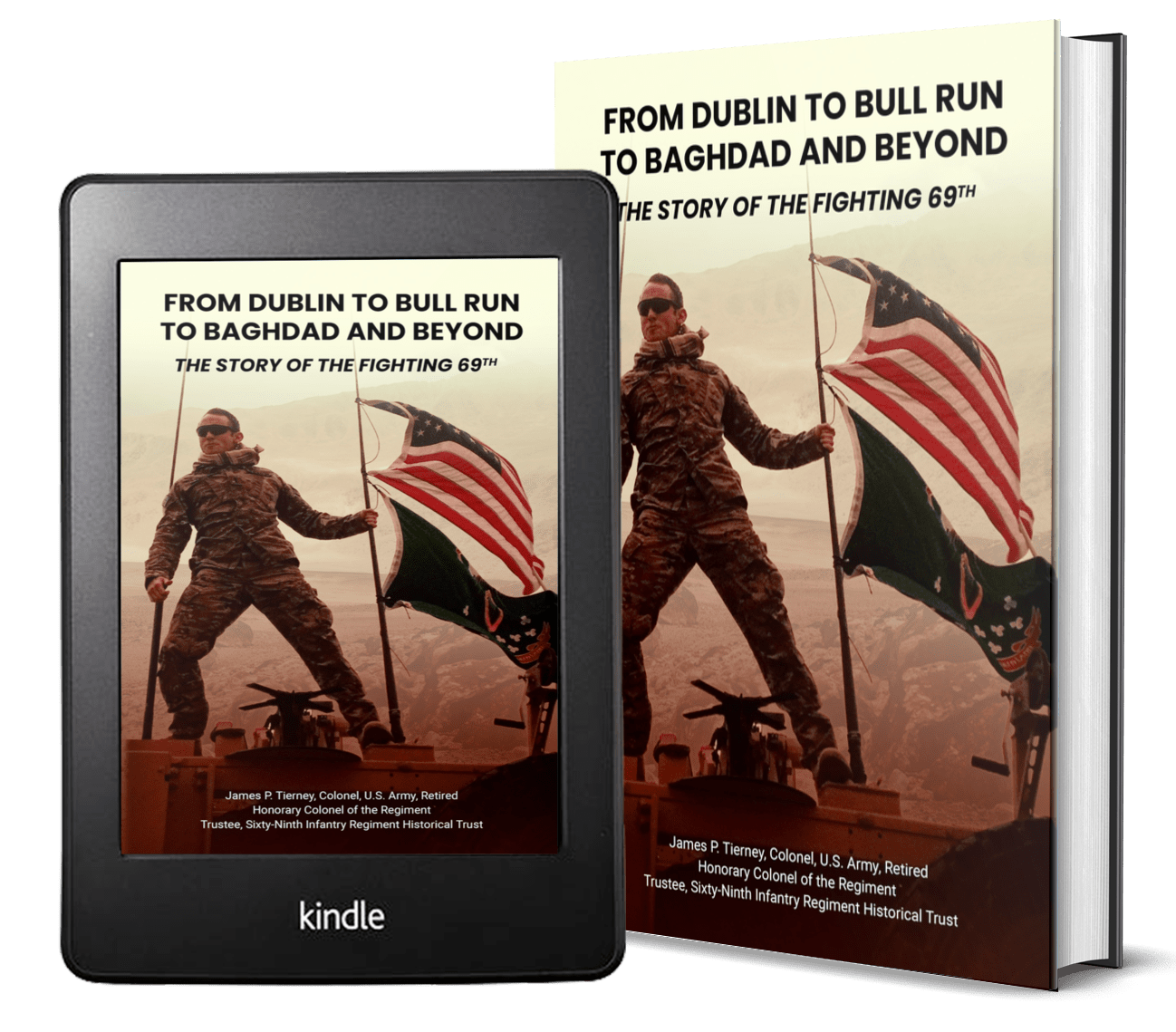
The Civil War saw some of the most brutal and bloody battles in American history, and among the most feared and respected units were the Fighting 69th and the Irish Brigade. While the 69th Infantry Regiment was the backbone of the Irish Brigade, these two entities developed distinct identities over time. In Dublin, to Bull Run, to Baghdad and Beyond, James P. Tierney highlights their shared origins and the unique contributions each made to Union victories.
A Common Origin: The Irish Warriors of the Union Army
Both the 69th Infantry Regiment and the Irish Brigade were born out of Irish nationalist sentiment. Many of the men had fled Ireland after the failed Young Irelander Rebellion of 1848 and saw service in the Union Army as a way to prove their loyalty to America while keeping the dream of Irish independence alive.
The 69th New York State Militia was already an established Irish regiment by the start of the Civil War. When President Lincoln called for volunteers, the 69th was among the first to answer, led by Colonel Michael Corcoran.
Inspired by their bravery at Bull Run, the Union Army decided to expand the concept into a full Irish Brigade, which was officially formed in 1861 under Brigadier General Thomas Francis Meagher. The 69th became the core regiment, joined by the 63rd and 88th New York, as well as regiments from Pennsylvania and Massachusetts.
Battlefield Legacy: Who Was More Feared?
Both units earned their fearsome reputations in some of the most vicious battles of the war.
The Fighting 69th at Bull Run
- The 69th was one of the few regiments to hold its ground during the Union’s disastrous defeat.
- Captain James Haggerty was killed leading a charge, and Colonel Corcoran was captured, further cementing the regiment’s reputation for fearlessness.
The Irish Brigade at Antietam
- The Irish Brigade played a decisive role in one of the war’s bloodiest battles.
- Ordered to charge against Confederates at the Sunken Road, they fought so fiercely that the area became known as “Bloody Lane”.
- The Brigade suffered over 60% casualties in that battle alone.
Gettysburg: The Defining Moment
- The 69th, still part of the Irish Brigade, was once again at the center of the action.
- Ordered to hold their ground at Cemetery Ridge, they repelled multiple waves of Confederate assaults, including Pickett’s Charge.
- General Meagher’s leadership ensured that the Irish Brigade would go down in history as one of the fiercest fighting units of the war.
Comparing Their Legacies
| Category | Fighting 69th | Irish Brigade |
| Size | One regiment (part of Irish Brigade) | Multiple regiments from NY, PA, MA |
| Famous Leaders | Michael Corcoran, Robert Nugent | Thomas Francis Meagher |
| Most Famous Battle | Bull Run | Antietam |
| Casualties | High | One of the highest casualty rates in the Union Army |
| Reputation | Known for stubborn defense and holding the line | Known for aggressive charges and relentless attack |
Conclusion
While the Fighting 69th and the Irish Brigade were deeply connected, their tactics, battle roles, and legacies diverged. The 69th was the unshakable core, always holding the line, while the Irish Brigade was the Union’s shock force, sent into the deadliest assaults.
Both units, however, cemented their place as among the most feared and respected in the Union Army, proving that Irish soldiers were some of the fiercest warriors in American history.