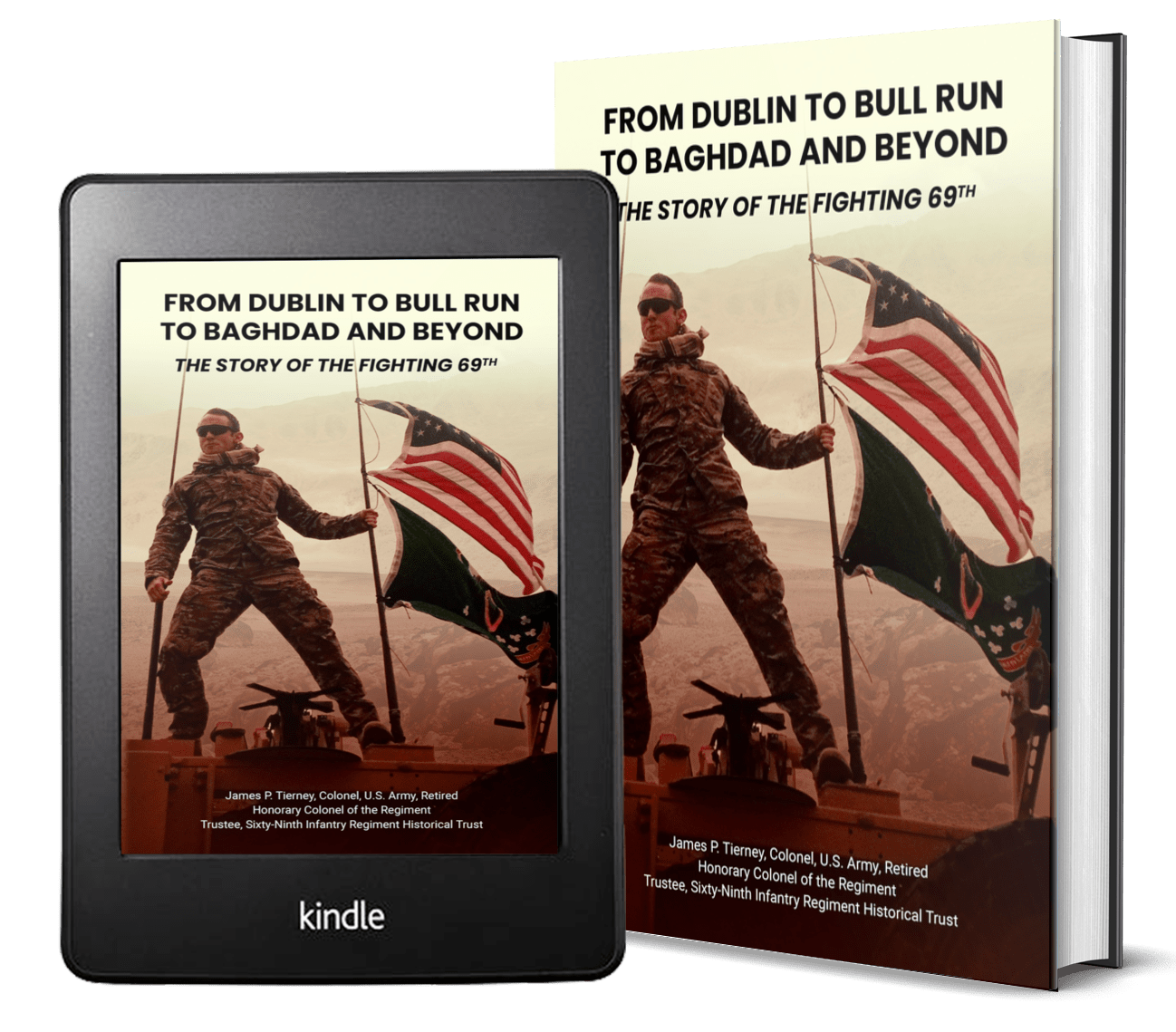
The Battle of Bull Run (First Manassas), fought on July 21, 1861, was the first major engagement of the American Civil War—and it was here that the Fighting 69th earned its reputation as one of the Union Army’s most fearless units. As described in Dublin, to Bull Run, to Baghdad and Beyond by James P. Tierney, the regiment, composed largely of Irish immigrants, refused to break under fire, making a bold stand against Confederate forces.
Marching to Battle
When President Lincoln called for troops in April 1861, the 69th Regiment was one of the first to respond. Led by Colonel Michael Corcoran, the regiment was part of Brigadier General William T. Sherman’s brigade, assigned to attack Confederate positions near Manassas, Virginia.
Before departing, they marched proudly through New York City, cheered on by thousands of Irish-American supporters. Their distinctive green flags, emblazoned with Irish symbols, set them apart from other Union regiments, reinforcing their unique identity as Irish warriors fighting for the Union.
Holding the Line Under Fire
As the battle began, the Union Army initially pushed Confederate forces back, but the tide turned when Confederate reinforcements, including the famous “Stonewall” Brigade, counterattacked.
The 69th was ordered to cross Bull Run Creek and advance on the enemy, but they encountered fierce resistance from Confederate artillery and infantry. Despite suffering heavy casualties, the regiment held its position, refusing to retreat even as other Union units began to fall back.
The Death of Captain James Haggerty
One of the regiment’s most devastating losses came when Captain James Haggerty, a respected officer, attempted to rally his men for an attack on a retreating Confederate unit. As he charged forward on horseback, he was shot and killed—becoming one of the first officers to die in the battle.
Haggerty’s death shook the regiment, but rather than retreat, they fought even harder, determined to avenge their fallen leader.
Colonel Corcoran’s Capture and the Aftermath
As the battle spiraled into chaos, the Union Army collapsed into a full retreat. However, unlike many regiments that fled in disorder, the Fighting 69th withdrew in formation, maintaining their discipline even under Confederate pursuit.
During the retreat, Colonel Michael Corcoran was captured, making him one of the highest-ranking prisoners taken by the Confederacy. While in captivity, Corcoran refused to recognize Confederate authority, becoming a symbol of Irish defiance. His capture would later inspire massive recruitment efforts in New York, as Irish Americans sought revenge.
A Lasting Reputation
The Fighting 69th was one of the only Union regiments to leave Bull Run with its honor intact. While the battle was a disaster for the Union, the 69th had proven its unwavering courage.
Their performance at Bull Run set the stage for their role in the Irish Brigade, where they would continue to fight in some of the bloodiest battles of the Civil War, including Antietam, Fredericksburg, and Gettysburg.
The Battle of Bull Run was the baptism of fire for the Fighting 69th, marking the beginning of their legendary Civil War service. Despite the chaos, casualties, and capture of their commander, they stood firm when others fled, proving that the Irish soldiers of the Union Army were among its toughest warriors.
The bravery displayed on that battlefield cemented their legacy, ensuring that the name “Fighting 69th” would be remembered for generations to come.