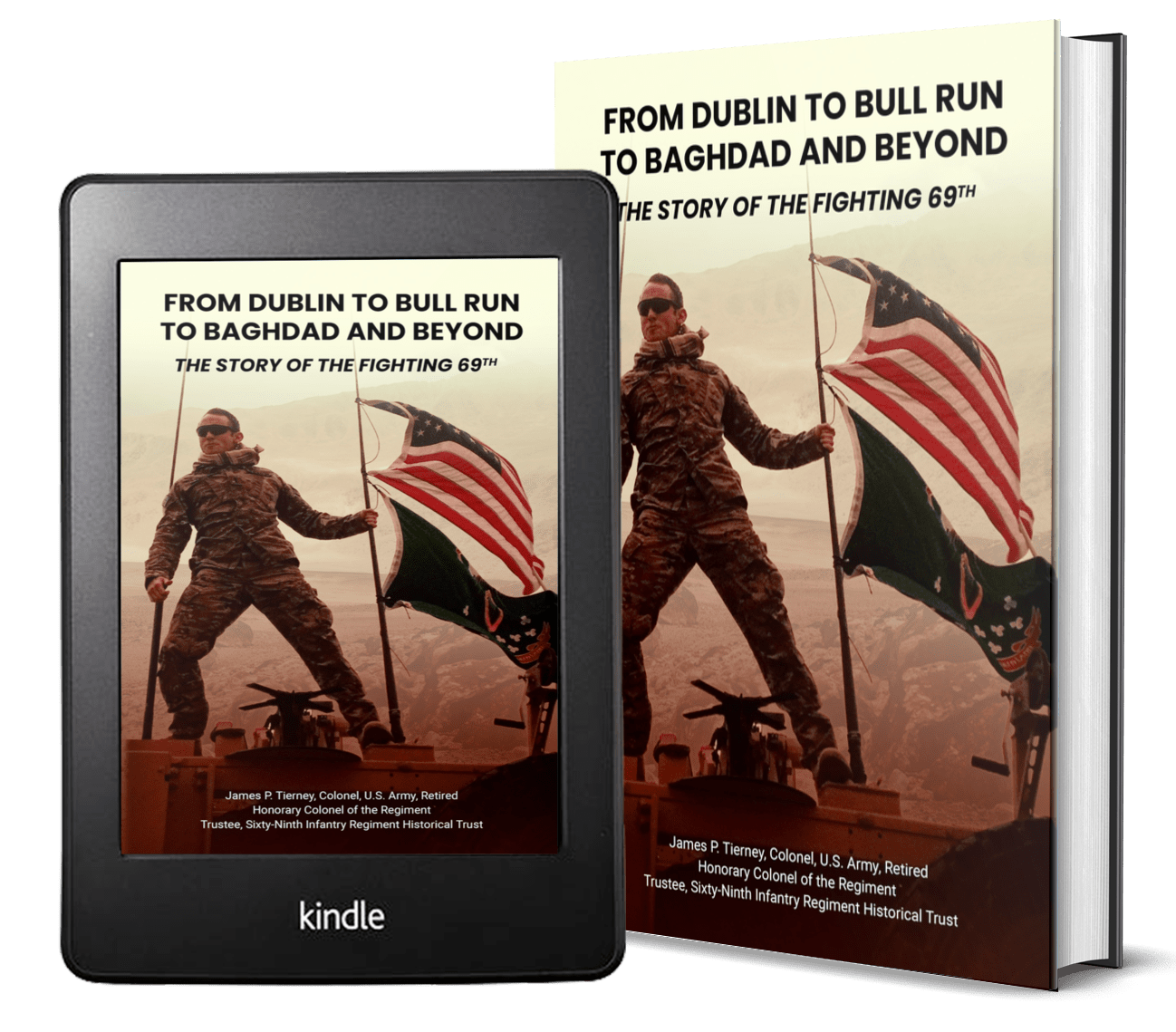
In From Dublin to Bull Run to Baghdad and Beyond, James P. Tierney does more than just recount the history of the 69th Infantry Regiment; he breathes life into a transatlantic tale of defiance, heritage, and unbreakable spirit. For those who seek to understand how identity, politics, and military history converge across continents and centuries, this book is a masterclass in storytelling.
At the core of Tierney’s exhaustive work is the story of how political turmoil and cultural resilience in 19th-century Ireland sparked the formation of one of America’s most celebrated military units. The 69th Infantry Regiment, famously known as “The Fighting 69th,” was not formed in a vacuum. Its roots were sown in the hunger and repression of 1840s Ireland—a time when Catholic citizens were stripped of rights, and famine ravaged the land while British landlords exported grain. Against this grim backdrop, revolution was not just inevitable; it was imperative.
Tierney weaves in the influence of European nationalist movements, particularly Giuseppe Mazzini’s Young Italy, to show how revolutionary fervor spread across borders. Inspired by Mazzini, Irish nationalists like William Smith O’Brien, Thomas Francis Meagher, and Michael Doheny launched their own movement—Young Ireland—seeking freedom for the Irish people through force rather than parliamentary compromise.
When their 1848 uprising failed, many of these leaders fled to New York City. What follows is one of the most compelling transitions in the book: the migration of revolutionary dreams from Ireland to America. Tierney brilliantly narrates how these exiled Irish nationalists, including Meagher and Doheny, became the architects of the 69th Regiment. They did not leave their struggle behind; they transformed it into an American cause, tying the liberation of Ireland with the defense of their new homeland.
One of the book’s most riveting segments details how these Irish patriots organized Irish-American companies, armed themselves with pikes and muskets, and eventually became part of the New York State Militia. Through secret societies like the “Silent Friends” (early Sinn Féin), and pivotal leaders like Michael Corcoran and James Houston, Tierney paints a vivid picture of underground coordination, ideological tenacity, and a community mobilized by shared purpose.
But From Dublin to Bull Run to Baghdad and Beyond is not just about history; it is about lineage, legacy, and continuity. The regiment’s story spans generations—fighting not only in the Civil War but also in both World Wars, Operation Iraqi Freedom, and more. Tierney’s meticulous documentation of battles, political influences, regimental reorganizations, and key figures ensures that this is not just a military record but a dynamic saga.
Perhaps the most touching theme of the book is how the 69th Regiment became a symbol of Irish-American identity—where Irish heritage and American patriotism did not conflict but coalesced. From wearing green frock coats modeled after the Club 82 jackets of Young Ireland to carrying their green flags, every detail in the regiment’s visual culture signaled a deeper historical narrative.
Tierney’s writing is deeply informed by personal experience. As a former Colonel in the Army and Honorary Colonel of the 69th, his perspective is both scholarly and lived. His dedication to honoring the soldiers of the regiment—past, present, and future—is palpable on every page.
In a world where identity and nationalism are being reevaluated, From Dublin to Bull Run to Baghdad and Beyond offers a vital lesson: heritage and duty, when united by values, can create enduring legacies.